
When William the Conqueror’s surveyors arrived in the Lincolnshire settlement of Gainsborough in 1086, they found a modest farming community on the banks of the River Trent. Yet this small entry in the great survey belies a place that had, just seventy years earlier, stood at the very centre of English history. The Domesday record of Gainsborough offers a fascinating window into how the Norman Conquest reshaped one of England’s most storied towns.
Before Domesday: A Town of Kings and Vikings
To understand what the Domesday surveyors found at Gainsborough, it helps to know what had come before. The place-name first appears in the Anglo-Saxon Chronicle of 1013 as Gegnesburh — meaning “Gegn’s fortified place” — and the town’s strategic position on the River Trent had already made it a place of national importance. Gainsborough was one of the capital towns of the Anglo-Saxon kingdom of Mercia, and its riverside location made it accessible to seafaring vessels travelling inland from the Humber estuary.
In 1013, Sweyn Forkbeard, King of Denmark, sailed his Viking fleet up the Trent and made Gainsborough his base of operations during his conquest of England. It was here that the English lords of the Danelaw submitted to him, and Gainsborough briefly became, in effect, the seat of English royal power. Sweyn died at Gainsborough in February 1014 — reputedly just five weeks after being declared King of England — making him one of the shortest-reigning monarchs in English history. His son, Cnut (Canute), would go on to consolidate Danish rule over the whole country.
By 1066, then, Gainsborough had a rich heritage stretching back through centuries of Anglo-Saxon and Scandinavian settlement. The Norman Conquest would bring yet another upheaval — and the Domesday Book would record the results.
What Domesday Tells Us
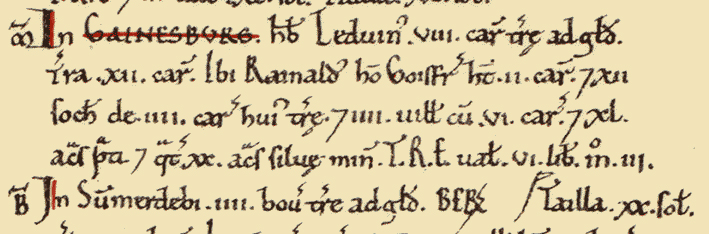
The Domesday Book — that extraordinary manuscript survey commissioned by William the Conqueror in 1085 and completed the following year — recorded Gainsborough under its Norman-era spelling, Gainesburg. The entry is concise, as all Domesday entries are, but it reveals a great deal when read carefully.
Gainsborough was recorded within the Hundred of Corringham, one of the administrative divisions of Lincolnshire. Lincolnshire itself was one of the largest counties surveyed, containing some 780 separate places in the Domesday record — a reflection of its status as one of the most densely settled parts of England at the time.
Population
The survey recorded 16 households at Gainsborough, broken down as follows:
- 4 villagers (villani) — these were small-scale farmers who typically held around 30 acres of land and owned a pair of oxen for ploughing.
- 12 freemen (socmani or liberi homines) — these individuals held their land with greater personal freedom than the villagers, and could in theory sell or transfer their holdings.
Since Domesday recorded only the heads of households, the actual population was likely around five times larger — placing Gainsborough’s total population at roughly 80 people. It is thought that around 70% of these inhabitants were of Scandinavian descent, a legacy of the town’s deep connections to the Danelaw.
By Domesday standards, 16 households was a relatively modest settlement. Neighbouring Corringham, for instance, recorded 34 households, while nearby Scotter had 60. For a town with such a dramatic recent history, Gainsborough in 1086 was a surprisingly small community.
Agricultural Resources
The land at Gainsborough was measured at 12 ploughlands (carucatae). A ploughland was the area that a team of eight oxen could plough in a year — generally reckoned at around 120 acres, though this varied with the quality of the soil. Twelve ploughlands therefore represented a substantial tract of arable land, perhaps in the region of 1,400 acres.
To work this land, the entry records:
- 2 lord’s plough teams — oxen teams belonging to the manor lord
- 6 men’s plough teams — oxen teams belonging to the tenants
This gives a total of 8 plough teams working 12 ploughlands, suggesting that the land was not being cultivated to its full capacity. This shortfall between potential and actual ploughing capacity is a pattern seen across many Domesday entries, and may reflect a decline in the local labour force in the decades following the Conquest — particularly in the north of England, which had suffered severely during William’s notorious “Harrying of the North” in 1069–70.
Beyond the arable fields, Gainsborough also had 40 acres of meadow — valuable land used for grazing livestock and producing hay — and 80 acres of woodland.
Notably absent from the Gainsborough entry are any mills, fisheries, or a church. The absence of a mill is somewhat surprising for a riverside settlement, and the lack of a church is confirmed by later records — the first church at Gainsborough was not built until 1209, when it was established by the Knights Templar.
Value and Lordship
The Domesday entry records the annual value of the Gainsborough estate to its lord. In 1086, this was assessed at £3. In 1066 — before the Conquest — it had been worth £6. This halving of value is striking and tells a powerful story. Across much of northern England, estate values plummeted between 1066 and 1086, often as a direct consequence of the violent upheavals of the Conquest years and William’s brutal suppression of northern resistance.
The lordship of Gainsborough had changed hands entirely between the two dates:
- Before the Conquest (1066): The lord was Leofwin, identified as the father of Leofric — an Anglo-Saxon nobleman.
- After the Conquest (1086): The tenant-in-chief — that is, the person who held the land directly from the Crown — was Geoffrey of la Guerche (Geoffrey de Guerche), a Norman knight. The immediate lord over the local tenants was a man called Rainald.
This transfer of ownership from an Anglo-Saxon lord to a Norman tenant-in-chief was, of course, the central story of the Domesday Book itself. William had redistributed virtually all of England’s landed wealth to his followers, and Gainsborough was no exception. Geoffrey de la Guerche held extensive lands across Lincolnshire and other counties, part of the new Norman aristocracy that now controlled the country.
Reading Between the Lines
What can we deduce from this brief entry about life in Gainsborough in 1086?
First, the high proportion of freemen — 12 out of 16 recorded households — is characteristic of the eastern counties of England, particularly Lincolnshire and the old Danelaw territories. Scandinavian legal traditions placed a stronger emphasis on personal freedom than Anglo-Saxon customs further south, and this is reflected throughout the Domesday entries for Lincolnshire. The freemen of Gainsborough would have had more control over their land and labour than the unfree peasants (servi) who are commonly recorded in the southern and western counties.
Second, the dramatic fall in value — from £6 to £3 — hints at real hardship. Whether this was caused by the disruption of the Conquest itself, by the Harrying of the North, or by the simple upheaval of new lordship and changed demands on the tenants, the people of Gainsborough were clearly worse off in 1086 than they had been a generation earlier.
Third, the absence of a church is worth noting. Many Domesday settlements, even quite small ones, had a church and a priest. That Gainsborough did not suggests that, despite its earlier political significance, by 1086 it had not yet developed the kind of ecclesiastical infrastructure that characterised more established market towns.
After Domesday: The Town That Grew
The Domesday snapshot captures Gainsborough at something of a low ebb. But the town would not stay small for long. The Lindsey Survey of 1115–1118 records that Gainsborough had passed to the Norman lord Nigel d’Aubigny, forebear of the powerful Mowbray family. A weekly market charter was granted by King John in 1204, signalling the town’s growing commercial importance. And in the 1460s, Thomas Burgh built the magnificent Gainsborough Old Hall — one of the best-preserved medieval manor houses in England, which still stands today.
From a Domesday community of perhaps 80 souls, Gainsborough grew steadily into the thriving market town and river port that it remained for centuries. But it all begins with that spare, factual entry in William’s great survey — a few lines of medieval Latin that freeze a moment in time, and invite us to imagine the lives of the farmers and freemen who worked the land beside the Trent nearly a thousand years ago.
Sources: Open Domesday (opendomesday.org); Gainsborough Town Council heritage pages; Wikipedia; Mayflower 400 project; GENUKI Lincolnshire church records.

Comments(2)
Mark Killelay says
12th April 2026 at 7:45 amLove the History of Gainsborough as my Dad Eric Killelay came from there and actually came to Gainsborough Ipswich to Marry my Mum Eric’s Dad was William Killelay from Bole and was a one armed Willow cutter and was Buried in the middle of a field West Burton near the Power Station that was
Jill Potts (nee Oliver) says
4th July 2026 at 9:08 pmThese are fascinating articles. Thank you for posting them. I was born and brought up in Gainsborough and left in 1965 when I finished school.
I have cataracts and it would be so much easier to read them if they were in black rather than grey.
Recent posts
Events