
The Gainsborough and Saundby WWI Airfield
When people think of Gainsborough’s industrial past, they think of Marshall Sons & Co., the Britannia Ironworks, Roses and packing machines. Aviation doesn’t usually make the list. But for two years between 1916 and 1918, a field on the Nottinghamshire side of the River Trent served as one of the Royal Flying Corps’ key home defence landing grounds in the region, and Gainsborough played a more significant role in the air war over Britain than most people realise.
The airfield is sometimes listed simply as “Gainsborough” in aviation records. More precisely, it sat in the Parish of Saundby, south of the Ramper Road (the A631, then known as the Flood Road), on land that had previously been occupied by a Victorian rifle range. The distinction matters: the field was in Nottinghamshire, across the Trent from Gainsborough, yet the town provided the squadron’s headquarters, its administrative infrastructure, and its burials. The two places were inseparable.
A county under threat
Lincolnshire’s geography made it both a corridor and a target. The North Sea coast was the shortest route from the German mainland, and from 1915 onwards the county’s residents knew what it sounded like when a Zeppelin engine droned overhead in the dark. The raids were not merely symbolic. In January 1916, three civilians died in Scunthorpe from a Zeppelin bombing raid. A few weeks later, an attack on Humberston and Cleethorpes killed 32 soldiers in a single strike.
These were bombs falling on streets and billets. The public response was furious, and in February 1916 the Royal Flying Corps formally took over home air defence from the Royal Naval Air Service. Three squadrons were tasked with Lincolnshire’s skies.
The squadron that chose Gainsborough
No. 33 Squadron RFC was formed on 12 January 1916, drawn from No. 12 Squadron at Filton airfield near Bristol. Its purpose was unambiguous from the start, home defence. The squadron chose Gainsborough as its headquarters, the town from which it would coordinate the defence of northern England against German airship attacks.
The squadron’s administrative base was established at The Lawn, a large detached house on Summer Hill, overlooking the town and the River Trent. The house’s grounds were filled with wooden huts to accommodate the clerks, cooks, drivers and headquarters staff, while aircrew were billeted in the main house itself. The officer commanding was Major Arthur Thomson, described in contemporary accounts as a youthful and enthusiastic officer. Ground crews, meanwhile, were housed rather less comfortably in the old Gainsborough Workhouse.
The squadron’s flights spread across the county. A Flight went to RAF Scampton (then known as Brattleby), B Flight to Kirton in Lindsey (initially operating from a site near Manton), C Flight to Elsham Wolds. Additional landing fields were maintained at Blyborough, Cockthorne Farm and Cuxwold, with a flight station at Brattleby. The network wasn’t a luxury. Intercepting a Zeppelin in darkness, over a blacked-out countryside, in the aircraft available in 1916, meant pilots needed somewhere to land wherever fuel and circumstance demanded.
The Saundby field
The landing ground in Saundby parish was modest. Around thirty acres, situated on the west bank of the Trent, south of what is now the A631. No permanent runways. The land was requisitioned from a local businessman and huts and hangars were erected on site.
One inherited asset was the old Firing Range, a Victorian structure dating from the late 1880s, consisting of a long earth mound called the Butts where targets were placed, and a series of firing points stretching back 600 yards towards Saundby. The RFC pilots and ground crews made practical use of it. The Butts were a convenient location for testing the .303 calibre Lewis machine guns fitted to their aircraft before operations.
The field operated as a night landing ground, not an airfield in any modern sense, but a strip where pilots could take off into the darkness and, if fortunate, find their way back when the patrol was done.
The aircraft that operated from it are among the most recognisable of early RFC service. The Royal Aircraft Factory BE.2 came first, followed later by the FE.2.
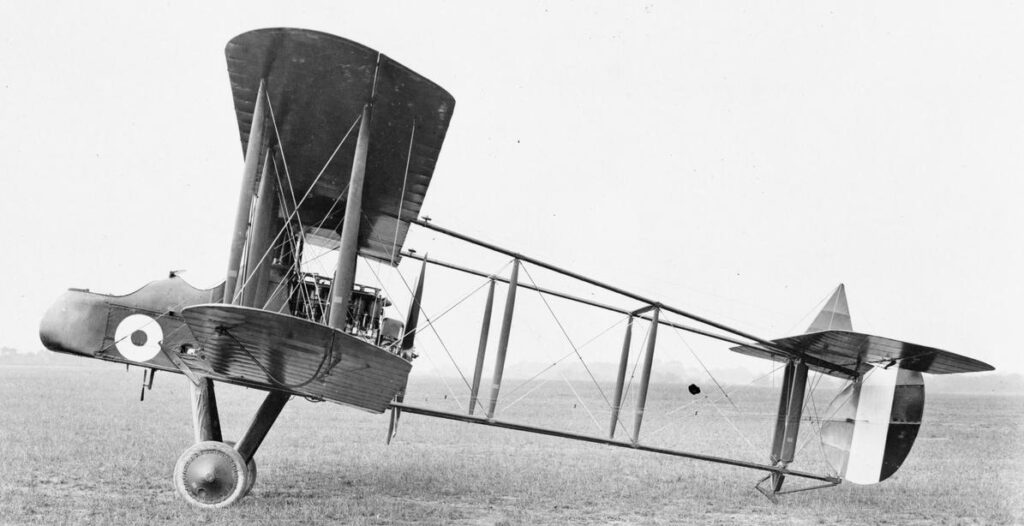
The BE.2 was slow and inherently stable, qualities that made it badly vulnerable on the Western Front, but genuinely useful at night. Its steadiness was forgiving under the worst conditions a pilot might encounter: darkness, cloud, disorientation. For the home defence role, BE.2s were stripped to single-seaters, fitted with an auxiliary fuel tank and a Lewis gun mounted to fire upward at forty-five degrees. The tactic, attacking a Zeppelin from directly below, worked. On the night of 2–3 September 1916, Lt. William Leefe Robinson downed the SL 11 airship over Cuffley in a BE.2c, the first German airship brought down over Britain. Robinson received the Victoria Cross. By the end of that year, five more Zeppelins had been destroyed by home defence aircraft.
The FE.2, the “Fee” in RFC slang, was a pusher biplane, engine behind the pilot, observer up front in the nose. Long outclassed as a day fighter by 1917, it found a second life at night. Its stable handling and unobstructed forward view suited the long patrols and difficult landings that home defence demanded.
A training squadron is born
On 5 September 1917, the Saundby field took on a second function. No. 192 Squadron RFC formed there as a dedicated night training unit, flying both the FE.2b and FE.2d variants. The need was real. Night flying demanded skills that daytime training simply didn’t develop, reading instruments without natural horizon cues, navigating by ground features under moonlight, landing on a strip defined only by flare pots. Pilots who hadn’t learned to do these things in training tended to solve them badly on operations.
No. 192 Squadron moved to Newmarket, Suffolk in 1918 and disbanded there in December. It had spent less than a year at Saundby, but its formation there confirmed the field’s position as a genuine operational hub in the home defence network, not just an administrative address.
By mid-1918, No. 33 Squadron had progressively re-equipped. Bristol F.2B Fighters replaced the FE.2s in June, and dedicated Avro 504 night fighters followed in August. The Zeppelin raids had largely wound down by 1917 anyway, German losses were rising and British defences had outpaced German airship technology faster than anyone in Berlin had anticipated. The final German airship raid on Britain took place in August 1918.
No. 33 Squadron disbanded in June 1919 without having destroyed a single enemy airship. That fact appears in the records without apology, which seems right. Finding and shooting down a hydrogen-filled airship in total darkness, from an aircraft with no radio, no radar and no standardised night navigation aids, while the airship climbs away above you, is harder than it sounds. The squadron made several interceptions. That they came close matters more than the final tally.
The human cost
Eight aircrew died during the period of the airfield’s operation, and most of them were buried in Gainsborough. Their graves are in the General Cemetery on Cox’s Hill. The cemetery contains 41 Commonwealth war graves from the First World War, and among them are the men who died not in France, but here, in training accidents and operational mishaps above the fields and villages between Gainsborough and the Humber.
Research by local historian Peter Bradshaw has identified six young airmen from Canada, South Africa, New Zealand and Argentina who perished in flying accidents and are buried there. Their nationalities are a reminder of something easily overlooked, the home defence squadrons drew from across the Empire, not just from English counties. Young men crossed the Atlantic and the Indian Ocean to train as pilots, and some of them died not over the Western Front but over Lincolnshire and Nottinghamshire, within sight of the Trent. We will tell more of their story in another post.
The church of St Martin in Saundby carries a brass war memorial plaque on its south wall, listing the men of the parish who fell in the First World War. The airfield that stood in its fields for two years is not mentioned there. Maybe it should be.
The Marshall connection
There is one further strand to this story, partly documented, partly still open to question.
In 1917, Marshall Sons & Co. secured a contract to build Bristol F.2B Fighters at a new facility on Lea Road in Gainsborough, known as the Carr House Works. Four purpose-built workshops were erected. Over the life of the contract, 147 aircraft were completed, a significant manufacturing achievement for a firm better known for traction engines. The Bristol Fighter was powered by a 275-horsepower Rolls-Royce Falcon III V-12 engine and served as both a reconnaissance platform and a capable fighter aircraft. Building one in quantity required real precision engineering.
When completed, the aircraft were dismantled and transported by road to West Common in Lincoln for test flying. But some were flown directly from Layne’s Field in Gainsborough.
Mick Davis of the Cross & Cockade research journal raised the obvious question, was it possible that Marshall Sons & Co. also used the RFC’s Saundby field to test their Bristol-built machines? The Carr House Works were in Gainsborough. The landing ground was just across the Trent. The squadron at Gainsborough was already operating Bristol Fighters by mid-1918. The geography makes the connection hard to dismiss entirely. No documentary evidence has yet confirmed it. More on this part of the towns past another time.
What remains
The Saundby field closed in 1918. By 1919 there was nothing to mark it. The land returned to agricultural use and the infrastructure, huts, hangars, the requisitioned ground, disappeared within years. The Lawn on Summer Hill no longer serves any military purpose. The workhouse that housed the ground crews is long gone. Even the Victorian Butts of the rifle range, which the RFC borrowed for gun testing, are now just a grass embankment in a field.
What remains is a thread of documentation: squadron histories, a GENUKI entry for Saundby, a reference in the UK Airfield Guide, the West Lindsey Aviation Trail, and the Commonwealth war graves in Cox’s hill Cemetery. And the fact, worth stating plainly, that this was not a peripheral site. For two years, the headquarters of an active home defence squadron sat on Summer Hill, and the airfield that supported it sat on the far bank of the Trent in Saundby parish. Young pilots lifted off from that thirty-acre field into the darkness above the river and went to find the enemy. Some didn’t come back. Their graves are in Gainsborough, which is where they belong.
The heritage of this airfield sits across two counties and two parishes. It deserves to be properly documented before the last physical traces disappear entirely.
Sources
UK Airfield Guide — Gainsborough entry (ukairfieldguide.net)
NorthLincsWeb — RAF Elsham Wolds: Gainsborough/Saundby (northlincsweb.net)
No. 33 Squadron Association — squadron timeline (33squadronassociation.co.uk)
GENUKI — Saundby, Nottinghamshire (genuki.org.uk)
Beckingham cum Saundby Parish Council — Saundby Military Firing Range
West Lindsey District Council Aviation Trail (2018)
Brattleby Parish Council — Home Defence Flight Station Brattleby RFC
Wikipedia — No. 33 Squadron RAF; No. 192 Squadron RAF
National Transport Trust — Marshall Sons & Co. (nationaltransporttrust.org.uk)
Gainsborough General Cemetery — TracesOfWar.com
Peter Bradshaw — WW1 War Graves: Royal Flying Corps (Friends of the General Cemetery)
