
The RFC Officers of 33 Squadron buried at Gainsborough General Cemetery
On Cox’s Hill, in Gainsborough General Cemetery, overlooking the town they served, eight First World War graves belong to men of the Royal Flying Corps and Royal Air Force. Most of them never knew Gainsborough before the war brought them here. They came from Ottawa, Toronto, London, New Zealand, South Africa, and the Argentine Republic, drawn to this part of Lincolnshire by the adventure of flying and No. 33 Squadron RFC, which made the town its headquarters from 1916 to 1918.
Not one of them was killed as part of the war over France. They died over England, in training accidents at night, in crashes during Zeppelin alerts, in the ordinary dangerous business of learning to fly in darkness with inadequate instruments and unreliable aircraft. The youngest was just nineteen, with the oldest being twenty-nine. Between 2011 and 2012, the Friends of Gainsborough General Cemetery restored their headstones and held several ceremonies to mark the occasion. But their stories deserve telling properly.
This article focuses on four of the men whose names appeared on the restoration ceremony programme: Lieutenant John Bernard Brophy, Lieutenant James Arthur Menzies, 2nd Lieutenant Carey Pinnock, and Lieutenant Frank Allyn Benitz. All four men served with 33 Squadron and are buried in Gainsborough General Cemetery. The following article draws on their own words, those of their families, contemporary newspaper accounts, and the National Archives.
Lieutenant John Bernard Brophy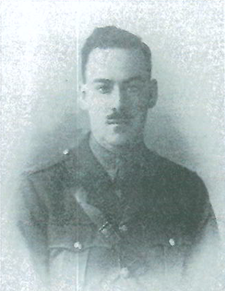
From: Ottawa, Canada
Died: 24 December 1916, aged 23
Cause: Flying accident at Hibaldstow, near Kirton-in-Lindsey
Aircraft: BE12
Buried: Gainsborough General Cemetery, the first RFC officer buried here
“Don” Brophy, as his fellow officers knew him, left Ottawa to join the Great War on 8th December 1915 at the age of twenty-two. He said goodbye to his family, and as was tradition before going to war, he had made his will before he left.
He completed his training to become a pilot while in Canada, learning to fly on flying boats, before joining the RFC and being sent to France. Based at Hesdin with 21 Squadron, he flew reconnaissance and bombing missions before being injured in a crash on landing in August 1916 when his plane hit a lorry. He was back on operations within weeks, and on 16th September he was Mentioned in Despatches. A few days later he was in action again, firing seventy rounds at a lone German aircraft, and the encounter appeared in the Royal Flying Corps Communiqué as a believed kill, his first appearance in the official record.
He kept a diary, which was later published as A Rattle of Pebbles: Diary of Two Canadian Airmen, by the Government of Canada. It gives an unusually direct account of what flying on the Western Front actually felt like. He describes the strain of continuous operations, fellow pilots going home shattered by nerves, and the creeping sense that survival was a matter of arithmetic rather than skill. By the 25th July he had completed ten bombing raids over the lines, more than anyone else in the squadron.
In late October 1916 he received orders to join 33 Squadron in Lincolnshire, with its headquarters at Gainsborough. The home defence role suited a man of his experience, with his new focus being to intercept and destroy the aircraft of the German Zeppelin raids.
“Some of the best men in the Flying Corps have been brought back and engaged as Zep chasers, so I feel proud of myself at times.”
“If I ever get close to a Zep you can bet that I won’t fumble it.”
From one of Lt. Brophy’s last letters home, written 21 December 1916
Three days after writing those words, on Christmas Eve 1916, the airframe of his BE12 failed while he was flying near Hibaldstow, close to Kirton-in-Lindsey. The aircraft spiralled into the ground, and he was killed; he was twenty-three years old.
His military funeral was held at St Thomas of Canterbury Catholic Church on Cross Street. Major Thomson, the commanding officer of 33 Squadron, was among those present. Lieutenant Brophy was Canadian, and there were no relatives at the funeral; he was buried on 29 December 1916, the first RFC officer to be interred on Cox’s Hill. The Gainsborough News reported the ceremony on 2 January 1917, and the cemetery register records him simply: “John Bernard Brophy, 23, Lieut Royal & Corps, George Hotel Kirton Lindsey.”
Lieutenant James Arthur Menzies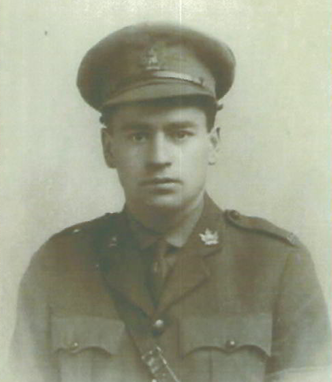
From: Ottawa, Canada (76th Battalion att’d RFC)
Died: 24/25 September 1917, aged 21
Cause: Aircraft crashed into trees near Elsham during night patrol, 3.30 a.m.
Aircraft: FE2d A12
Buried: Gainsborough General Cemetery beside Lt. Brophy
James Arthur Menzies arrived at Gainsborough in the summer of 1917 and wrote home to his family in Canada; his letter of 8 July captures what the aerodrome was like from the inside:
“I’ve been having a fine rest here at Headquarters. The Adjutant told me that I was going to be Squadron Machine Gun Officer… I am attached to Headquarters Flight for flying. We are taught night flying here… I haven’t done any flying at night as yet.”
James Arthur Menzies, letter home, 8 July 1917
He described the aerodrome itself, its position on the bank of the Trent, the townspeople gathering at the edge of the field in the evenings to watch the flying, the strange spectacle of the tidal bore moving up the river. It was, he wrote, a quiet place. He had been to the gunnery school at Turnberry and had just been made Squadron Machine Gun Officer on the strength of it.
“Gainsborough is a quiet place. The people generally congregate on the edge of the Aerodrome, in the evening, and watch the flying…The river here has what is called the Aegar; I would call it a tidal bore. It comes up with the change of the tide. When the tide first starts to come in it comes with a rush of water about three feet high. It is rather exciting to watch the small boats breasting this Aegar.” Arthur
Arthur Menzies was, by his brother Percy’s account, one of the most willing pilots on the squadron and volunteered for Zeppelin patrols repeatedly. In August 1917, just back from sick leave and having flown the available aircraft only once at night, he volunteered to go up during a Zeppelin alert. A more experienced pilot turned up at the last moment, and the commanding officer stood him down; his disappointment was evident.
On the night of 24 September 1917, the squadron was scrambled again after seven Zeppelins were reported. Arthur asked three times to be allowed to fly, firstly asking to go up with Major Thomson himself, but the Major was flying a specially rigged single-seater with no room for a passenger. He then asked twice to fly from the C Flight at Elsham, and this time the Major relented, not because the risk was low, but because he trusted Menzies to make the most of the opportunity if it arose.
At 3.30 in the morning, the FE2d carrying Menzies and his pilot crashed into trees in a wood near Elsham. The pilot, 2nd Lieutenant Carey Pinnock, survived, but Menzies was killed; he was twenty-one years old.
His brother Percy, who attended the funeral with their brother John, described it in a letter to their parents in Canada. Arthur was brought back to Gainsborough on the morning of Saturday 29th September and placed in the headquarters building at The Lawn on Summer Hill, the great old mansion, Percy wrote, standing back amongst trees and overlooking Gainsborough in the hollow. He lay in the large hall under the Union Jack, flowers banked around him, four sentries at the corners.
The procession moved off at 11.15 am with about thirty soldiers of the Lincoln Battalion marching as a firing party, having travelled all the way from Grimsby. Arthur’s coffin was placed on a gun carriage, his sword and cap on top and about sixty air mechanics and then the officers marched behind in two lines. They buried him beside Don Brophy, and Percy wrote that a fine tree seemed to caress the spot with its dancing sunlight. Three volleys were fired, followed by the Last Post, then the great crowd of civilians closed in.
2nd Lieutenant Carey Pinnock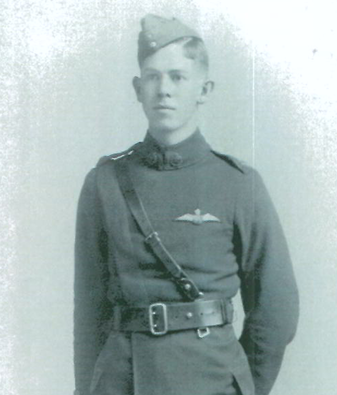
From: Toronto, Canada (201st Battalion, then RFC)
Died: 30 November 1917, aged 20
Cause: Flying accident — error of judgement on turns close to the ground
Aircraft: FE2d A6416
Buried: Gainsborough General Cemetery
Carey Pinnock had survived the crash that killed Arthur Menzies, but just two months later, he was also dead.
He had come a long way to reach that aerodrome; his parents were missionaries who had spent twenty-six years in Nigeria with the Baptist Board of the Southern States, and were based in Richmond, Virginia, when the war began. Carey had been one of the first young men to enlist in the battalion of high school boys which Colonel Hagarty recruited in Toronto. He transferred to a University Battery, then to the Flying Corps, before crossing to England for training.
Carey gained his pilot’s certificate in remarkably short time and was put directly into home defence, training further in night flying with the intention of sending him to France for night work. During a German night raid, he crashed into a forest, killing his observer; he came out of that without injuries. The Toronto Daily Star ran the story under the headline “Toronto Aviator Meets Death in England — Had Narrow Escape During German Raid.”
On 30 November 1917, Carey Pinnock took a machine up for the purpose of testing it before operations. Turning close to the ground, he lost flying speed and crashed his FE2d. The Court of Inquiry later found that the accident was caused by an error of judgement on the part of the pilot in turning close to the ground. Carey was twenty years old and is buried in Gainsborough General Cemetery, the inscription on his headstone reading simply: “In His Service.”
Lieutenant Frank Allyn Benitz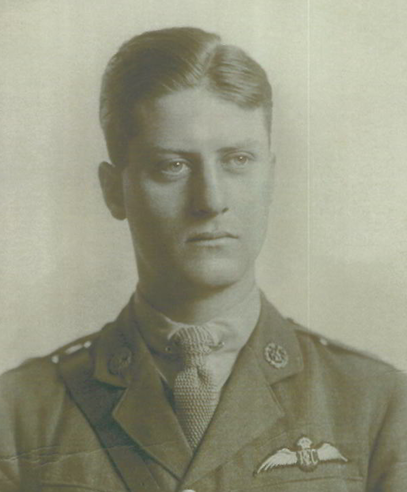
From: La California, Argentine Republic
Died: 5 August 1918, aged 25
Cause: Aircraft crashed on landing at Atwick during the last German airship raid on Britain
Aircraft: Bristol Fighter
Buried: Gainsborough General Cemetery
Frank Allyn Benitz came from La California, a town in the Argentine Republic, and joined the Royal Air Force, the RFC having become the RAF on 1 April 1918. He was twenty-five years old and by the summer of 1918 was flying Bristol Fighters out of Scampton, the same type that Marshall Sons & Co. were building at their Carr House Works on Lea Road in Gainsborough.
On the night of 5 August 1918, the last German airship raid on Great Britain took place. Five airships approached off the Norfolk coast between 8.30 and 9.30 in the evening; four of them dropped bombs harmlessly into the sea. The sounds carried over extraordinary distances, being heard at Bedford, ninety-five miles away, and at Weedon, 115 miles off.
The commanding officer of 33 Squadron received the warning just after half-past nine, but adverse weather conditions complicated everything. A pilot who had tested the air at Kirton-in-Lindsey reported clouds at 800 feet, saying he had climbed to 3,000 feet and still couldn’t get through. The officer commanding decided to wait for clearer conditions before scrambling his aircraft.
When he did act, Lieutenant F.A. Benitz and his observer, 2nd Lieutenant H.L. Williams, took off from Scampton in a Bristol Fighter. They developed engine trouble and descended at Atwick, some miles to the east, where they made repairs and went up again. The patrol lasted one hour and forty-five minutes, and on landing back at Atwick, the aircraft crashed; Benitz was killed, and Williams was seriously injured.
Frank never reached the Zeppelins. That night, at 10.15 p.m., Major E. Cadbury DSO and Captain R. Lockie DSO had intercepted the Zeppelin L.70 from Yarmouth Air Station and brought it down in flames eight miles north of Wells-next-the-Sea. The raiding airships did not reach the 33 Squadron patrol line and from that night on, the squadron’s duties shifted almost entirely to training night-flying pilots and observers. The Zeppelin war was over.
Frank Benitz was buried on 8 August 1918; he was the last of the four men named in the restoration ceremony. His headstone records that he was of La California, Argentine Republic. He is the only officer from the Argentine Republic buried in Gainsborough. The family photograph reproduced in Peter Bradshaw’s research programme shows Frank seated on the right, surrounded by his family at La California before the war. He looks like what he was: a young man from a prosperous Argentine family who crossed the world to fly.
The wider group
These four men were not the only RFC and RAF officers buried at Gainsborough General Cemetery during the war. In total, eight graves from No. 33 Squadron and its associated units rest on Cox’s Hill. They include 2nd Lieutenant Hubert Philip Solomon, a twenty-nine-year-old New Zealander who crashed at the landing ground at Gainsborough on 20 October 1917, a Jewish officer whose funeral was conducted by a Rabbi who travelled from Grimsby Synagogue; 2nd Lieutenant Laurens Jacoates Van Staden of South Africa, who married a local Gainsborough woman, Emmeline Beilby, just three months before he was killed in April 1918; and 2nd Lieutenant Frederick James Livingstone from New Zealand, who died in January 1918.
Six further members of 33 Squadron died in flying accidents during this period but were buried in their hometowns across England and Scotland, not at Gainsborough. Lieutenant Thomas Harold Coupe crashed at Scampton in July 1917 and is buried near Blackburn. Lieutenant Arthur William Rowlands crashed into a house at New Holland in August 1917 and is buried in Anfield, Liverpool. Lieutenant Harold Sanders Marshall and Flight Sergeant Frederick Bradshaw died in the same aircraft at Hibaldstow in January 1918, buried in Burton-on-Trent and Boothstown respectively. Lieutenant James Wilson Ross and 2nd Lieutenant James Lawrence Browne crashed together in March 1918; Ross died in the crash, Browne three days later in Grimsby Military Hospital and were buried in Edinburgh and Salford.
The headstone restoration project, led by Peter Bradshaw and supported by the Royal British Legion, Trent Valley Academy, the Friends of the Gainsborough Cemetery Chapel, and the Lincolnshire Co-operative Society, was completed in April 2012. It brought these graves back into visible, legible condition after decades of weathering and neglect. The ceremony that marked the occasion included serving officers from the present-day 33 Squadron and a reading of the Ode of Remembrance.
A note on the sources
The biographical information in this article draws primarily on Peter Bradshaw’s research document, produced for the April 2012 restoration ceremony, which incorporated letters from the Menzies family, records from the Government of Canada, newspaper archives including the Gainsborough News and the Toronto Daily Star, the No. 33 (H.D.) Squadron record at the National Archives, and the Commonwealth War Graves Commission register. Direct quotations from Lt. Brophy’s diary are from A Rattle of Pebbles: Diary of Two Canadian Airmen, Crown Copyright, Government of Canada, used with permission.
The graves on Cox’s Hill are in the care of the Commonwealth War Graves Commission. Anyone wishing to pay their respects will find the cemetery on Cox’s Hill, Gainsborough. The headstones, after their 2012 restoration, are clearly legible. Each one records where the man came from. They came from a long way away.
Sources
Peter Bradshaw — Ceremony to Mark the Restoration of Headstones of R.F.C./R.A.F. Officers (April 2012, Friends of Gainsborough Cemetery Chapel)
A Rattle of Pebbles: Diary of Two Canadian Airmen — Lt. John Bernard Brophy (Crown Copyright, Government of Canada)
Letters of Lt. James Arthur Menzies and Percy Menzies — supplied by the Menzies family
No. 33 (H.D.) Squadron record — National Archives
Toronto Daily Star, Tuesday 4 December 1917 (Carey Pinnock)
Gainsborough News, 2 January 1917 (Lt. Brophy’s funeral)
Commonwealth War Graves Commission — Gainsborough General Cemetery
UK Airfield Guide — Gainsborough/Saundby entry
NorthLincsWeb — Gainsborough/Saundby Airfield record
